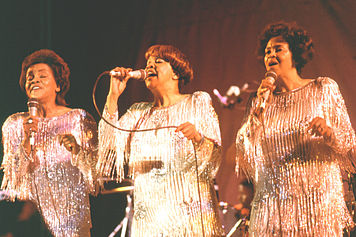
First, of course, there are the obvious similarities between The Head and the Heart's Charity Rose Thielen and Peter, Paul and Mary's Mary Travers: icy blonde hair, an arresting grace and vulnerability, a uniquely throaty voice. But the echoes of PP&M's influence are found woven throughout The Head and the Heart's sound in more complicated ways as well. Listen, for example, to the hauntingly pretty "Winter Song:"
Listen to the perfectly synced three-part harmonies (two baritones and a soprano). To the lilting and spare acoustic guitar backing. To the sadness.
These are all elements found in the music of pioneering folk trio Peter, Paul and Mary in the 1960s. What we think of as 1960s folk music was really a rediscovery (or revival, in the preferred vernacular) of the concept of "traditional music." The sound we associate with Folk Revival actually blended everything from British medieval court music to Appalachian bluegrass and created something new that sounded earthy and authentic and familiar; in essence, it was a new sound that seemed as though it had been around forever.
And no one encapsulated that new sound better than Peter, Paul and Mary. When Travers, Paul Stookey and Peter Yarrow recorded their first album together in 1962, they weren't creating a new sound; they were simply absorbing the elements of the Folk Revival that had begun in the 1950s and polished them to a pretty and widely palatable sheen, combining elements of humor and political statement into a familiar-yet-fresh folk sound. Their voices were untrained and unbalanced (they also had two baritones and a soprano), and they had their biggest hits either recording other people's songs or recording traditional tunes that had been around for decades. And yet despite their simplicity (or more likely because of it), they became so hugely popular that their influence continues to resonate 50 years later.
For example, compare "Winter Song" to Peter, Paul and Mary's "500 Miles:
You'll hear the same complex harmonies, the pleasantly uneven vocal balance, the resonating guitar accompaniment. And of course, the sadness. (Folk Revival was nothing if not beautifully sad.) So many of the elements that make Peter, Paul and Mary sound like they do manifest in one way or another on The Head and the Heart's self-titled debut album.
So remember, if you like The Head and the Heart, thank Peter, Paul and Mary.
Monday, December 17, 2012
Sunday, September 09, 2012
If you like Stornoway, thank Nick Drake
I stumbled across the song "Zorbing" by British indie band Stornoway (who are, ironically, not from Scotland), thanks to the Song of the Day project that actor/director/fellow Kenyon grad Josh Radnor has been doing on Twitter (which I cannot recommend highly enough):
It has the haunting, harmonic beauty of the British folk revival of the '60s (which ultimately inspired the corresponding folk revival in America). But there's also that infectious brass band riff that comes in halfway through the song, which is an element of the folk revival that is distinct to the U.K.
Which is why I was immediately reminded of one of the last British folk revivalists to have a national following -- the incomparable Nick Drake. Compare "Zorbing" to the song "Hazey Jane II" from Drake's 1970 release, Bryter Later:
You'll hear the same haunting vocal quality, though admittedly with less harmonizing than Stornoway applies. And yes, those are electric guitars rather than acoustic. But the brass band riffs take on a leading role in this song, driving the whole rhythm and energy forward, and it's suddenly easy to hear where Stornoway got the inspiration for "Zorbing."
So remember, if you like Stornoway, thank Nick Drake.
Friday, September 07, 2012
If you like John Legend, thank the Staple Singers
Heard this classic soul gem on the oldies station by the incomparable soul/R&B family, The Staple Singers:
It ran around my brain all day, sounding so very familiar. Where, where, where had I heard that string arrangement before? Just before bed, it came to me: it was the sample John Legend used in his breakout hit collaboration with Kanye West, "Number One":
Hear it? I think it's sampled directly from the Staples. And in borrowing the loop, John Legend turned the sentiment of the original song on its heel -- what was initially a song about getting busy with the one you love is inverted to a desperate apology for cheating on the one you love. By doing this, it's almost as though he's questioning the authenticity of the sentiment of the original song, calling the notion of faithfulness into question in the most dulcet possible way. Which I guess shouldn't be so surprising. John Legend is an Ivy League grad, after all.
So remember, if you like John Legend, thank the Staple Singers.
It ran around my brain all day, sounding so very familiar. Where, where, where had I heard that string arrangement before? Just before bed, it came to me: it was the sample John Legend used in his breakout hit collaboration with Kanye West, "Number One":
Hear it? I think it's sampled directly from the Staples. And in borrowing the loop, John Legend turned the sentiment of the original song on its heel -- what was initially a song about getting busy with the one you love is inverted to a desperate apology for cheating on the one you love. By doing this, it's almost as though he's questioning the authenticity of the sentiment of the original song, calling the notion of faithfulness into question in the most dulcet possible way. Which I guess shouldn't be so surprising. John Legend is an Ivy League grad, after all.
So remember, if you like John Legend, thank the Staple Singers.
Saturday, August 18, 2012
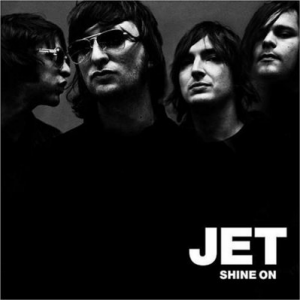
If you like Jet, thank The Who
But some modern bands are more careful students of The Who than others, and in my opinion, no one apes The Who better than Jet.
Take, for example, their ubiquitous 2003 single, "Are You Gonna Be My Girl?":
Despite the fact that it was extremely overplayed when it was first released, this song more than holds up. That infectious, complex bass line. The rollicking, fuzzy guitars. The raw, impossible-to-resist, get-up-out-of-your-seat-and-dance ENERGY of this song. (It is no wonder Apple chose this song for the first and best of their iconic "dancing silhouettes" ads.)
Musically, it is a page straight out of The Who's playbook. Listen to what is perhaps The Who's most famous song, "My Generation" from 1965:
Hear it? To quote Allmusic: "[This song is] a good nominee for rock's most explosive expression of adolescent rebellion. Guitar feedback, crashing drums, power chords..." All hallmarks you'll hear on an equally rebellious, explosive song by Jet almost 40 years later.
So if you like Jet, remember... thank The Who.
Saturday, June 30, 2012
If you like Carly Rae Jepsen, thank Annie Lennox
This is too easy, but I can't stop listening to this mashup, so I had to post it. Big tip of the hat to Vampire Weekend's Rostam Batmanglij for spotting the similarities between the song of the summer, "Call Me Maybe," and Lennox's "Walking on Broken Glass:"
Labels:
Annie Lennox,
Carly Rae Jepsen,
If Thank,
Vampire Weekend
Wednesday, June 27, 2012
If you like Fleet Foxes, thank Neil Young too
After reading my post, "If you like Fleet Foxes, thank Crosby, Stills & Nash," alert LTF reader Edley Naylor-Leyland pointed out that Fleet Foxes owe a musical debt to CSN partner Neil Young as well. To quote Naylor-Leyland, "Check out the similarities of Ohio (Young) and Mykonos (Fleet Foxes)- they use the exact same bit of Ohio at about 2min15secs."
So let's all take a listen. First, Neil Young's tragic anthem to the Kent State riot of 1970:
The sound is electric, minor-key heartbreak. But pay special attention to the vocal harmonies in the verse, especially "Gotta get down to it/ Soldiers are cutting us down."
Now listen to "Mykonos" by Fleet Foxes, paying special attention to the bridge around 2:15:
Well, I'll be damned. That is, in fact, the exact same vocal harmony and melody, especailly at "You go wherever you go today." So spot on that it sounds like an intentional homage to Kent State in my ear. Proving yet again that the indie rock so popular today takes great inspiration and sustenance from the classic rock that came before.
Great ear, Edley!
So let's all take a listen. First, Neil Young's tragic anthem to the Kent State riot of 1970:
The sound is electric, minor-key heartbreak. But pay special attention to the vocal harmonies in the verse, especially "Gotta get down to it/ Soldiers are cutting us down."
Now listen to "Mykonos" by Fleet Foxes, paying special attention to the bridge around 2:15:
Well, I'll be damned. That is, in fact, the exact same vocal harmony and melody, especailly at "You go wherever you go today." So spot on that it sounds like an intentional homage to Kent State in my ear. Proving yet again that the indie rock so popular today takes great inspiration and sustenance from the classic rock that came before.
Great ear, Edley!
Labels:
Crosby Stills and Nash,
Fleet Foxes,
If Thank,
Neil Young
Saturday, June 02, 2012
If you like Colbie Caillat, thank Fleetwood Mac
Okay, admittedly this one is a little too easy. Colbie Caillat is, of course, the daughter of famed music producer Ken Caillat, who gave some of Fleetwood Mac's best albums (including Tusk, Mirage and multi-platinum-selling Rumours) their distinctive warm-California tone. So it should be no surprise that Colbie harnesses the same likeable, breezy melodies as Fleetwood Mac, and adopts their focus on intimate relationships combined with the appealingly maximalist production tone that defined that megagroup of 1970s folk-rock. According to Fleetwood Mac fansite fleetwoodmac.net:
[Ken Caillat's] knowledge about how to get sounds recorded made Caillat an integral part of the team behind the mixing desk during those recordings. Lindsey Buckingham remembers the recording of "Go Your Own Way": "I really think Ken Caillat did a great job of getting the sound that solo needed. It defined an approach for years to come."
Buckingham was right in more ways than he intended: Caillat's distinctive production is a very successful approach that he is still putting to good use in the 2000s by producing all three of daughter Colbie's albums to date. Perhaps nowhere is his method more recognizable than in her song, "Falling for You:"
There are the warm, jangly, multiple-tracked acoustic guitars. There are the soft vocal harmonies. It's a pleasant, familiar, appealingly vintage sound. But then, when you get toward the end of the song, he drops in a signature riff, the one that sounds like birds flitting around the corners of the sonic landscape. You hear it after the bridge, when the vocals sing, "I can't stop thinking 'bout it, I want you all around me, and now I just can't hide it." Hear the subtle, dancing riff that's laid down over that? Does it sound familiar?
That's because Caillat and Buckingham first used it on Fleetwood Mac's Stevie Nicks-penned "Gypsy" from 1983's Mirage:
Still the warm, jangly tone. An even richer spectrum of background harmonies. And at the very end of the song, you'll hear a synthesizer riff that should sound very familiar.
So remember, if you like Colbie Caillat, thank Fleetwood Mac, and their consistently successful producer Ken Caillat.
Subscribe to:
Posts (Atom)